What
What are your options on removing carbon and maximising impact?
Cut emissions and regularly revise your strategy as best practice evolves.
Transition to carbon removal for any residual emissions.
Shift to removals with durable storage to compensate any residual emissions.
Support the development of innovative and integrated approaches to achieving net zero.

Carbon Removal is the human act of removing CO2 from the air.
-
Plants absorb CO2 through photosynthesis and store this is their biomass.
Afforestation, Reforestation, Blue Carbon, Improved Forest Management and Havested Wood Products are all ways to use plants to capture CO2 and store it in their biomass.
Depending on the plant, it may decay after years (e.g. the leaves) or centuries (e.g. wood used in buildings), re-releasing the CO2 back to the atmosphere.
-
Hybrid solutions aim to store the CO2 captured by plants for longer.
Like with Nature-Based Solutions, plants absorb the CO2 from the air using photosynthesis. We can then use different methods and technologies to stabelise the storage of that captured carbon so that it is removed from the atmosphere for centuries if not millenia.
Hybrid methods include Biochar, BioEnergy with Carbon Capture and Storage (BECCS), and Waste-to-Energy with Carbon Capture and Storage (WtE-CCS) or from bio-gas with Carbon Capture and Storage (Bio-CCS).
-
Technology solutions aim to bypass the dependence on plants for carbon removal, avoiding competition with arable land and the influence of climate change of plant growth.
CO2 naturally dissolves in water: the ocean already absorbs 25-30% of human-made CO2. Rocks also naturally react with CO2 and rain water - rock weathering. We can also use chemicals, Amines or Potassium Hydroxides, that are powerful enough to directly capture the 0.04% of CO2 in the air.
These Technological methods are Direct Ocean Capture, Ocean Alkalinity Enhancement, Enhance (Rock) Weathering or Direct Air Capture.
The CO2 is then stored for millenia in geological formations.
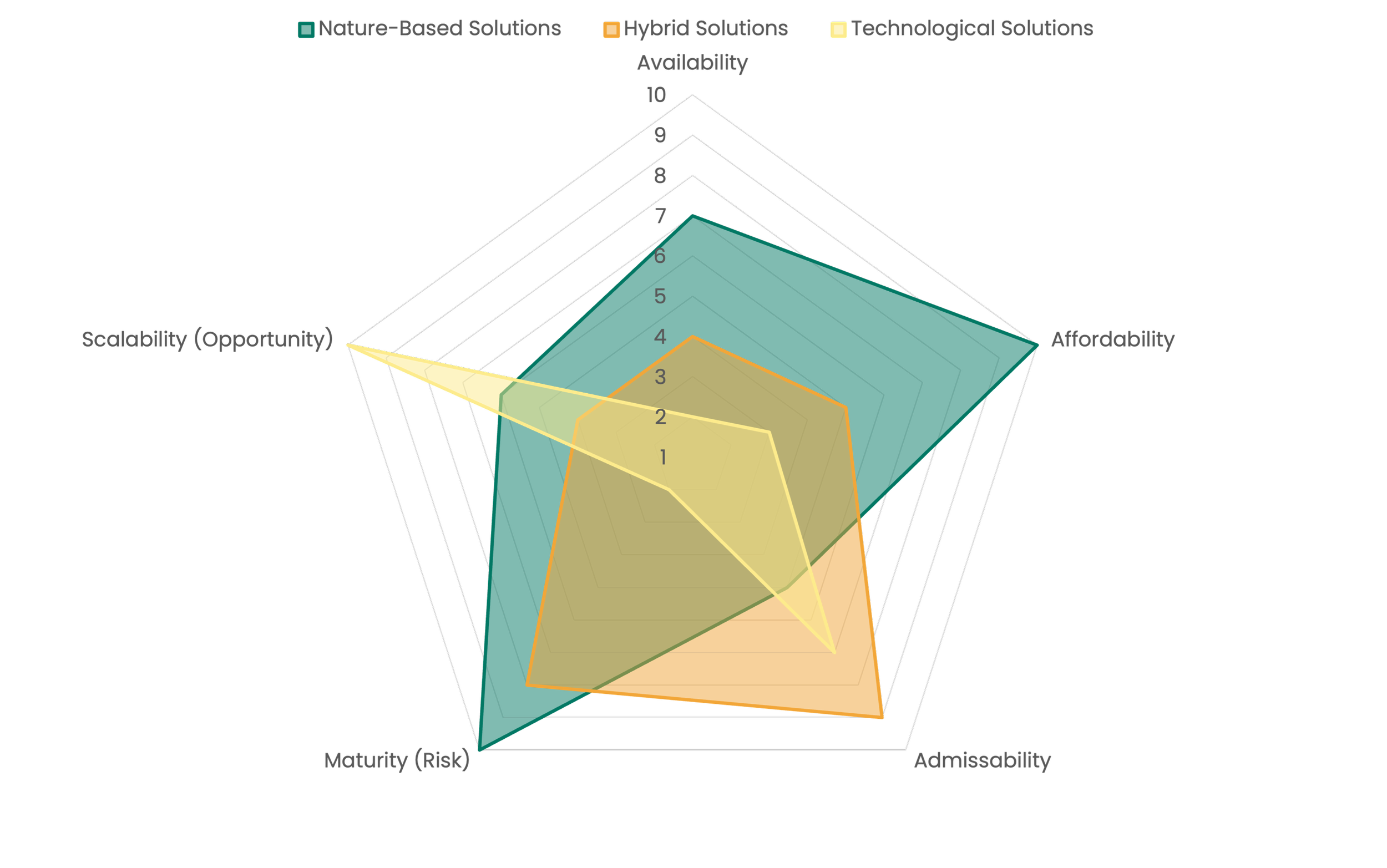
To visualise the merits and risks of carbon removal, Permutation has developed a simple tool